inSpace: Merging Industrial and Information Design ongoing
2005-present
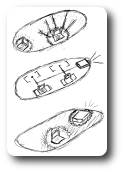
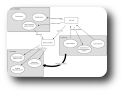
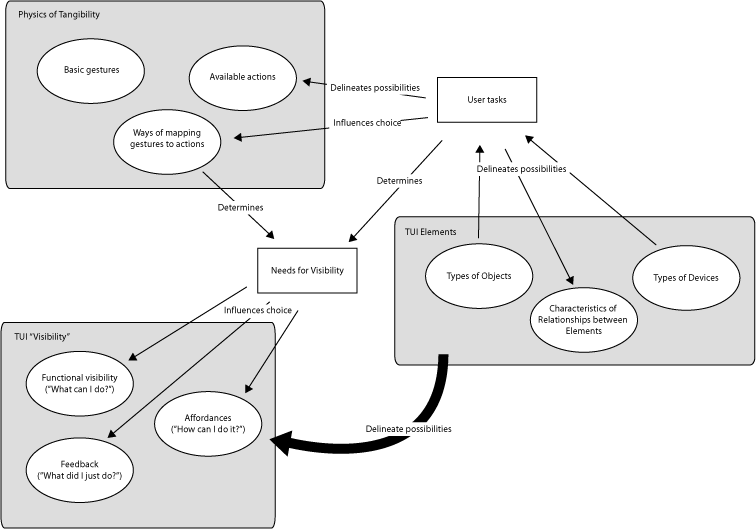
As part of my Master's project in the Georgia Tech HCI program, I am working with architects and industrial designers from Steelcase, Inc. to create combined physical and software interfaces to meeting room services. In this system, UIs present on a user's laptop or PDA can derive context from physical cues (such as the position and orientation of furniture in the room) and use those to anticipate user needs. I face several challenges as part of this project, including the selection of appropriate gestures and modalities for input as well as providing adequate physical feedback to the user. I currently plan to conduct a formative study with a few rough prototypes in January of 2006, followed by the construction of a high-fidelity prototype by the end of the Spring. This system will be installed in the inSpace meeting room, a joint project of Steelcase and several research groups at Georgia Tech to build a tightly integrated physical and information environment.
Digital Camera System redesign
2005
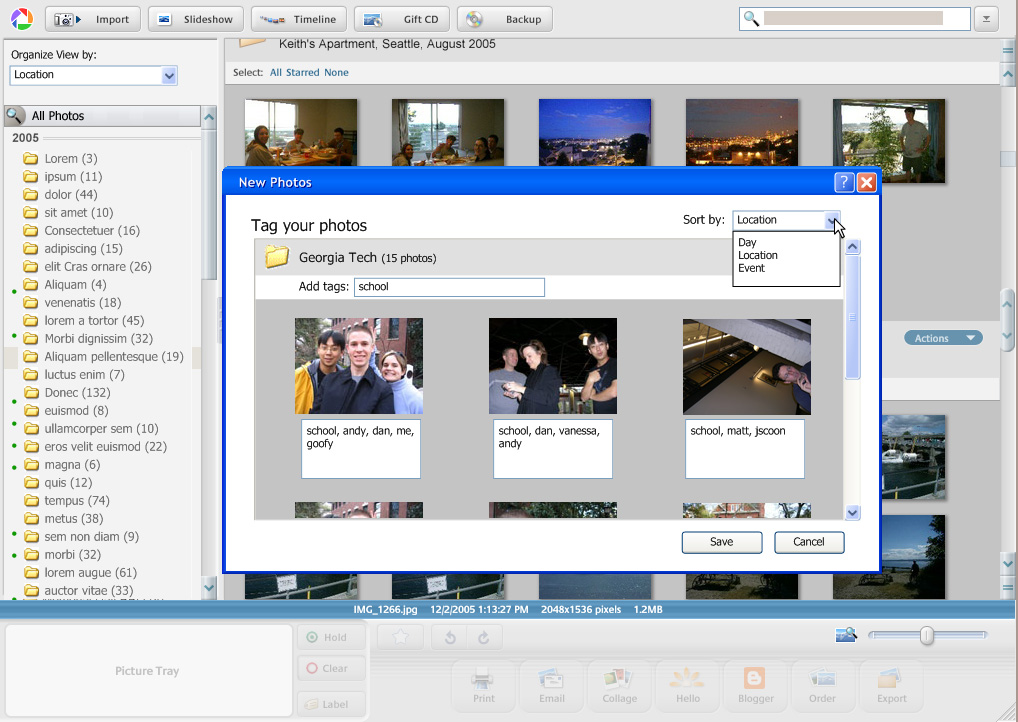
My five-person team was tasked with analyzing and redesigning an existing system -- in our case, we chose a digital photography system, including camera, organization software and communication tools for sharing.
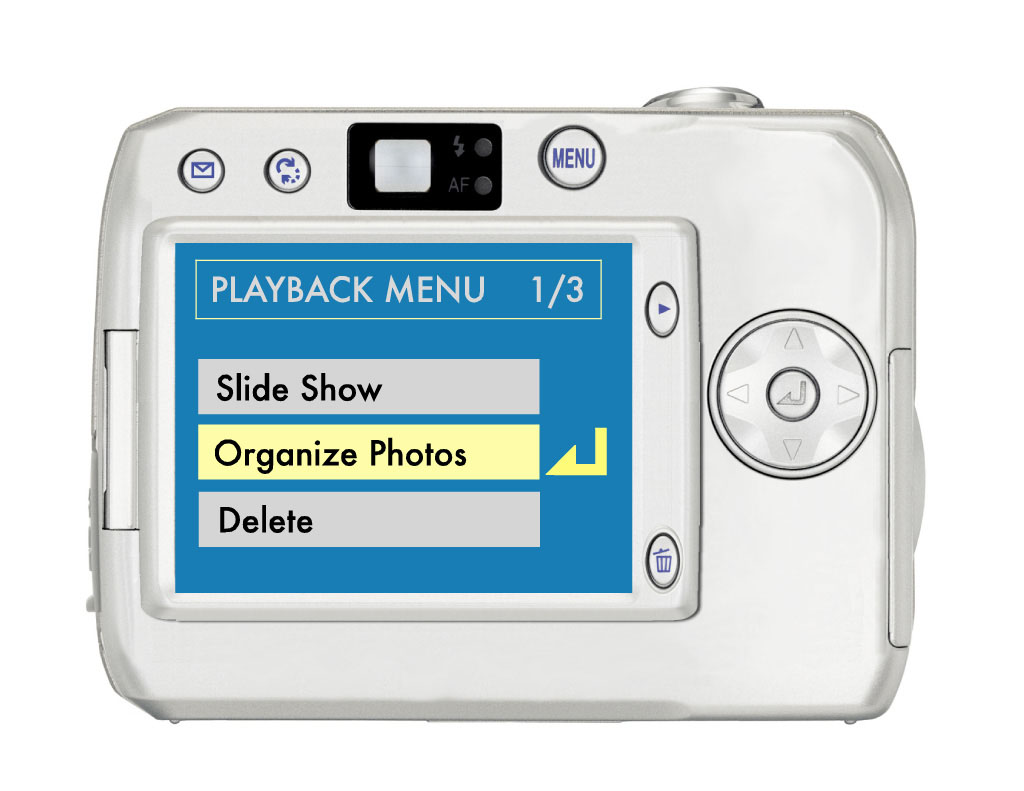
Our baseline camera was a Nikon Coolpix 3200, paired with the Picasa photo management software and Flickr photo sharing service. We interviewed users, constructed scenarios for use, analyzed user characteristics and profiled the task environment. We also exhaustively diagrammed the functional flow, decision-action sequence, operational sequence, and control flow of system usage at nearly every conceivable stage of modern digital photography. From these, we built a hierarchical task analysis, workload analysis, and a control profile for the typical user.
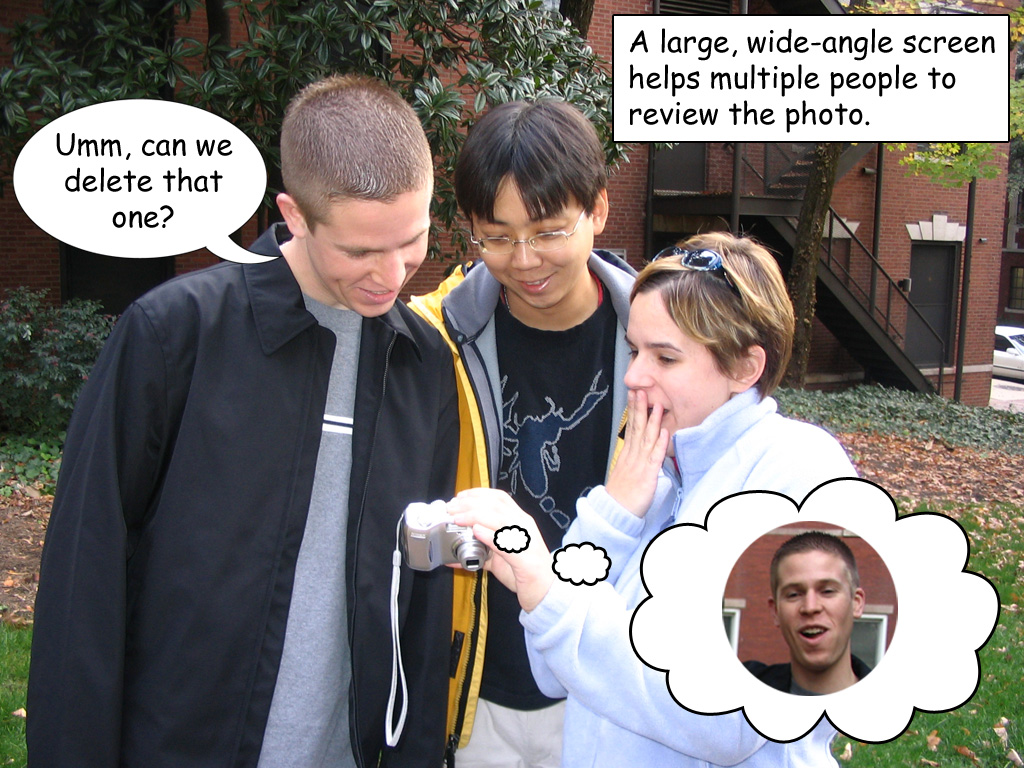
As part of this process, we identified the key problems with the system, which seemed to center on difficulty of use by amateurs as well as poor support for the common social tasks of digital photography. We developed a set of modifications to the camera body, camera firmware, photo management software and photo sharing tools that emphasized snapshots and sharing over the more technical side of photography. In order to effectively prototype a combined physical and digital system that was highly context-dependent, we created comic-book storyboards that illustrated how our modifications interacted with each other and were affeted by the task context.
A systems approach to design was a key factor in the success of our prototype. Throughout this project, we sought to understand digital photography as a phenomenon that extended beyond the camera itself into the physical, online, and social worlds. By bringing these together in an integrated fashion, we produced a redesigned photography system oriented towards the increasingly casual and social uses to which real people are putting their digital cameras.
Camera Luminarium
2005
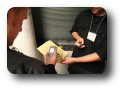
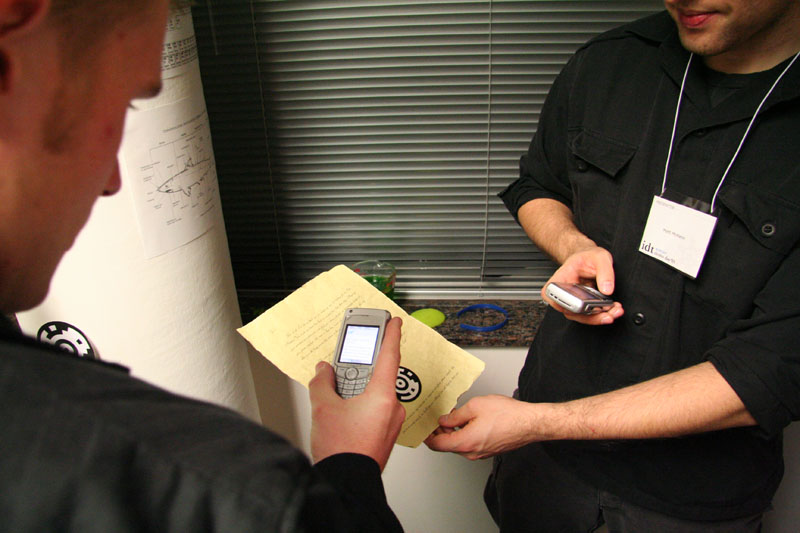
As part of my work with the Mobile Technologies Group at Georgia Tech, I teamed up with Dakota Brown and Elaine Huang to create Camera Luminarium. CL is a free-form, mixed reality puzzle game played with a camera-equipped mobile phone. The player enters a room with a number of objects and a locked box. By taking pictures of special barcodes on the objects, the player reveals elements of game's storyline which display on the phone. Clues in the story help players discover how the player can interact with the objects, how various objects can interact with each other, and how new barcodes can be revealed or unscrambled. The goal of the game is to gather all of the necessary clues to unlock the box and claim the prize inside.
My role on the project was primarily prototyping and detailed game design. We made use of Shotcodes to provide the glyph reading functionality. Camera Luminarium was first demonstrated at IDT Demo Day in December 2005 -- it was a great success, and we hope to show it again at the Living Game Worlds symposium in February 2006.
Amazon Gift Central
2005

Amazon Gift Central was a project to collect Amazon.com's many gifting features (such as wishlists, gift guides, and event notifications) into a single presence on the website. While interning with Amazon's gifting team as a user interface developer, I had several opportunities to contribute to Gift Central's design. I was apprenticed to the project's design lead, and in addition to general contributions I had responsibility for portions of Gift Central myself. These included the Gift Finder (which was dropped from the final version) and several different alternatives for integration of Gift Central content with the rest of the site.
Technique.Talk: an online community for Georgia Tech's newspaper
2005
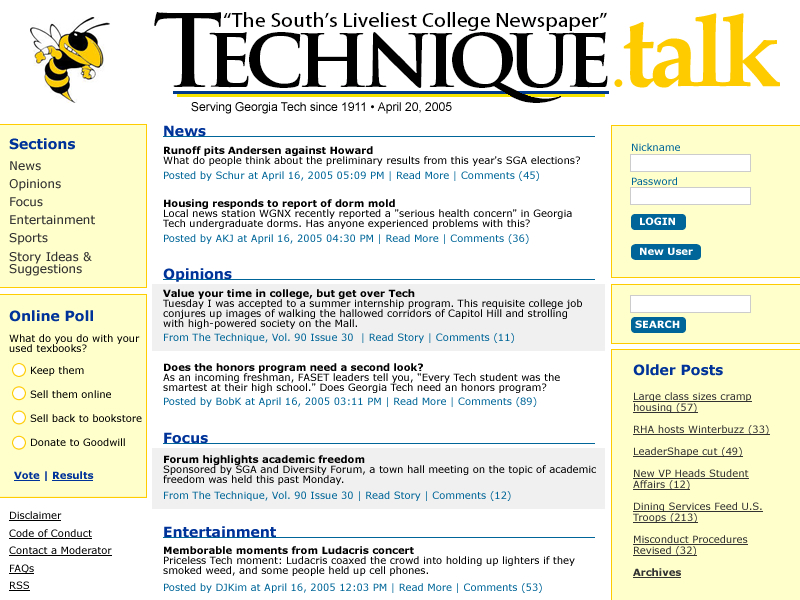
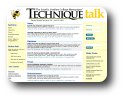 The Technique is Georgia Tech's independent student newspaper. Its current online presence, while adequate, lacks the sense of community and reader involvement present in many other news sites. Karyn Lu, Marcela Musgrove and I set out to design an online community for the Technique that would provide a forum for its readers' active participation.
We began by identifying three major groups of stakeholders within the Technique community: the Technique staff (including both editors and writers), likely contributors to the site (focusing on leaders of student organizations and those who had written letters to the editor in the past), and casual readers. We recruited interview participants from the first two groups, and conducted both face-to-face interviews and focus groups to identify their concerns and interests. For casual readers, we administered surveys (both paper and online) to elicit reading habits and their reaction to suggested features for a Technique community site.
Based on our findings, we created personas representing typical users in order to embody the needs and preferences of our participants. Using these personas, we then structured our design for the site (now named Technique.Talk) based upon Amy Jo Kim's 9 principles for online community design, seeking to address such diverse concerns as codes of conduct, leadership, recognition of status within the community, and integration with the real world. Some of the more significant challenges we faced included legal liability, editorial workload, student apathy, and the integration between prominent members of the Technique.Talk community and the rest of the Technique staff. We addressed these through pseudonymous identities keyed to GT student logins, a lightweight and open moderation scheme, tie-ins with features popular in the print edition of the Technique, and privileges for major contributors that rewarded their participation. We tuned our final design using scenarios detailing our personas' interaction with prototypes of the site.
Life Across Boundaries: Design, Identity, and Gender in Second Life
2005
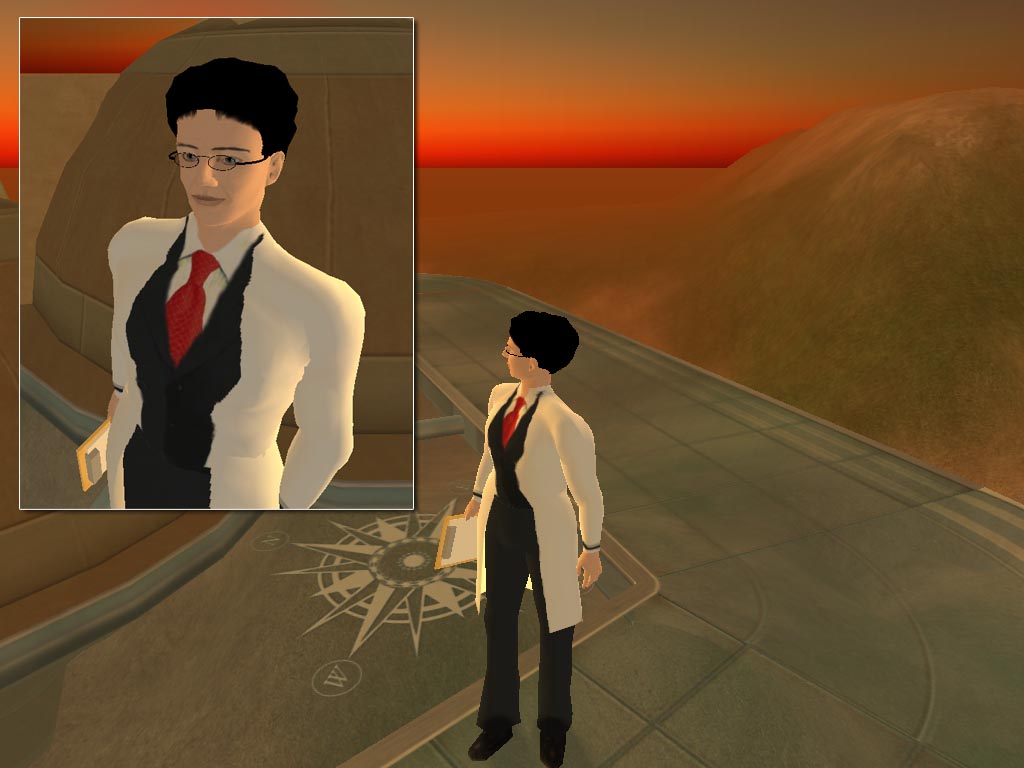
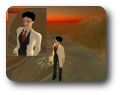 Second Life is an awe-inspiring massively-multiplayer online game. It is simple in concept -- create a persistent virtual world, allow players to create and customize avatars, then give them tools to build, shape, and script the world as they please. The result is a emergent community breathtaking in its scale and variety, with a vibrant economy and complex social dynamics. Together with Susan Wyche, I set out to answer several questions about gender, identity formation, and community in Second Life. In a world where a user can swap genders as easily as swapping outfits, one in which most limitations on appearance and self-expression are swept away, how does that user develop a community identity? How does the development of his or her Second Life identity impact "first life" identity?
After gaining approval for our project from Linden Lab, we conducted an extensive ethnographic study within the game world. We engaged in participant observation, playing the game as ordinary users in order to gain a first-hand perspective on the SL experience. Our phone interviews with over a dozen selected residents gave us a broad array of perspectives on the mechanisms that enable identity formation and reinforcement in Second Life.
The challenges of "virtual ethnography" are significant, and include both ethical and logistical concerns not present in traditional anthropological studies. For that matter, our findings were somewhat disappointing: the new mechanisms presented by Second Life merely confirm things that we've already known about online community identity since the days of MUDs and BBSs. However, a more promising avenue for further work lies in the study of Second Life's unique and open economic system. A number of fascinating and unexpected second-order communities have emerged from Second Life's basic design, all enabled in some fashion by the game economy. Understanding the ways in which a community design can successfully engender such second-order groups may lead us to better online communities in an increasingly complex social world.
Defining Personal Workspaces in a Collaborative Environment
2005
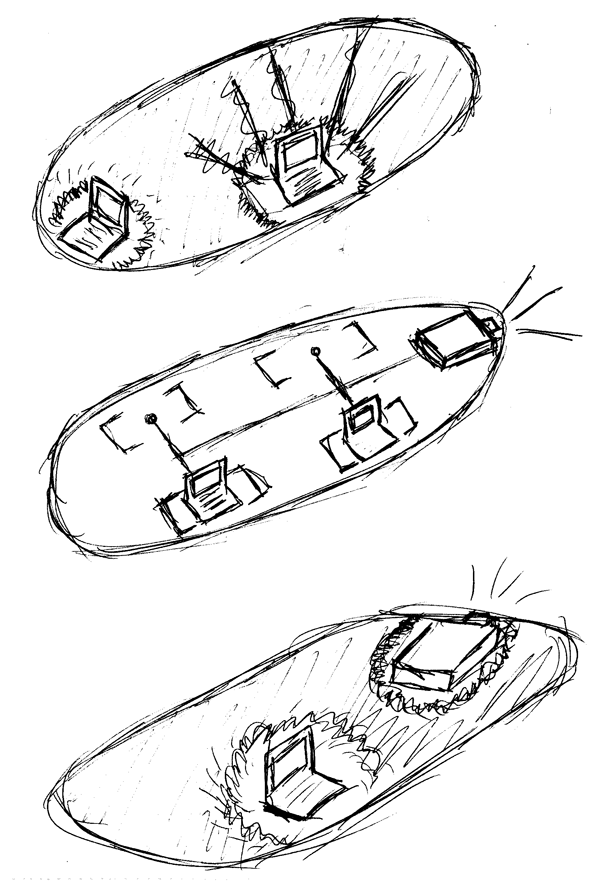
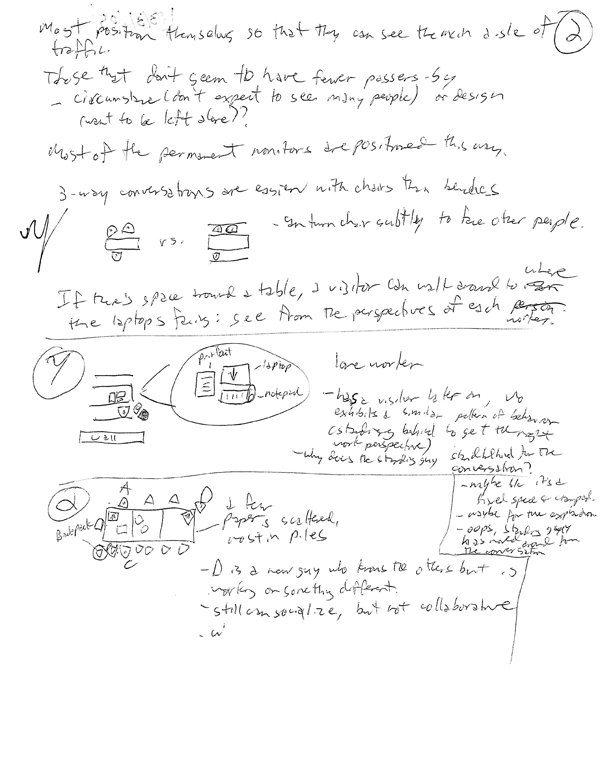
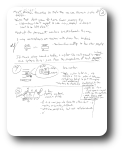 This was my semester project in a qualitative methods course. My partner and I conducted an ethnographic study of the usage of information devices (including laptops, mobile phones and PDAs) in public collaborative environments such as libraries and common areas in academic buildings. We observed student project groups working together in public areas around the Georgia Tech campus, and we made copious handwritten notes and diagrams to illustrate positioning and relative orientation. Our coding and analysis drew upon ethnomethodology and grounded theory to structure our observations into a coherent narrative. We found that users form personal "workspaces", delineated by their laptop screens, and that these workspaces serve an important role as social regulators for collaborative and disjoint work. They create a context for interaction, amplifying certain social cues and creating a power structure within the activity.
The Casablanca Digital Critical Edition
2004-2005
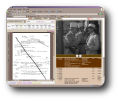 My first research assistantship at Georgia Tech was sponsored by The American Film Institute. Our project was to create a web application that streams film commentary and archival material from an AFI site, integrating it with local DVD content in the user's web browser. In addition to my responsibility for the authoring system, I consulted with both my advisor and my fellow students on the design of the front-end application. In the Fall of 2004 I implemented a proof-of-concept for this application, focusing on the connectivity between film, commentary, and archival materials such as the shooting script and production reports. I believe the simplicity, flexibility and richness of the resulting information architecture provides a powerful tool for film scholars. In subsequent demos, the concepts demonstrated by the prototype were well-received by both the AFI board and corporate visitors. Features from the demo were incorporated into the main application in the Spring of 2005.
On My Mind
2004
On My Mind was our class project for Introduction to HCI. I worked with three other graduate students: two from the HCI program and an industrial designer. We chose "Speed Dating" as our topic.
Speed Dating is a singles' event where participants go on 20 4-minute dates in a single evening. They record their preferences for the people they meet, then register those preferences on a website after the event. The organizer then calculates the mutual matches, and provides those couples with a means of contacting each other.
Our project identified problems with the process, designed a technological solution for those problems, and evaluated that design in a laboratory setting. We received a perfect score for our work; our TA said that our project "showed that high effort in both design and prototyping doesn't just make compelling products, but it also really opens up surprising avenues through which to talk about the fundamentals of HCI."
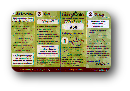 First, we developed an understanding of the problem through multiple approaches. We generated both a hierarchical task analysis and an entity-relationship diagram in order to deconstruct the speed dating process. I located existing studies of speed dating and collected statistics from speed dating websites, in order to obtain demographic data about participants. I also participated in a speed dating session and recorded my observations. Other members of the group performed an exhaustive study of speed dating articles and literature. Using these materials, we identified problems with speed dating that could be addressed by a technological solution, and developed a firm set of constraints that the solution would have to satisfice.
Next, we brainstormed design ideas and collected them into
three candidate designs. One of the team members sketched the designs, and we constructed an extensive
design space analysis to evaluate the relative suitability of our design elements. We presented our ideas in a
poster session, and incorporated our classmates' feedback into the construction of our prototype.
Our prototype was
On My Mind, a
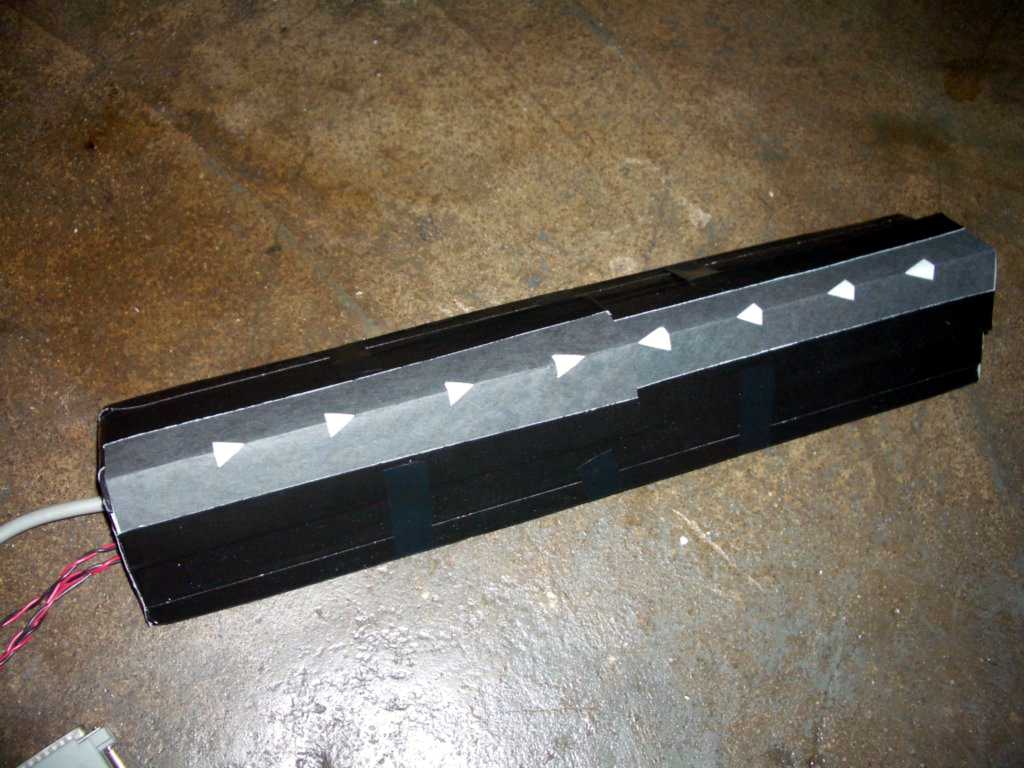
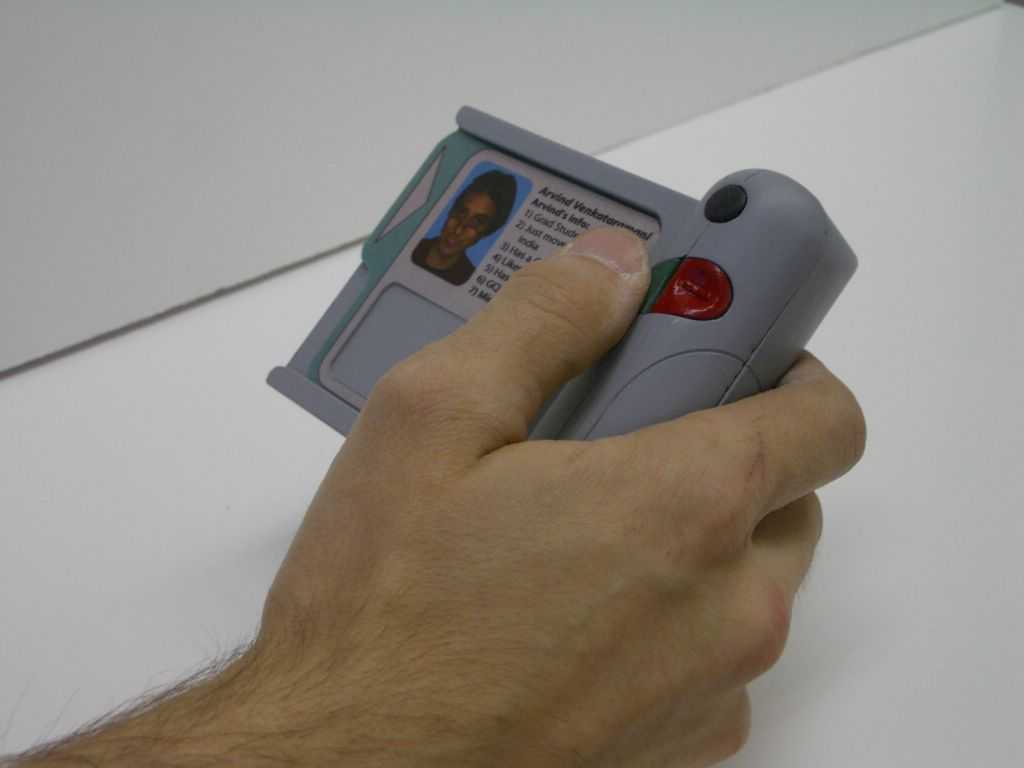
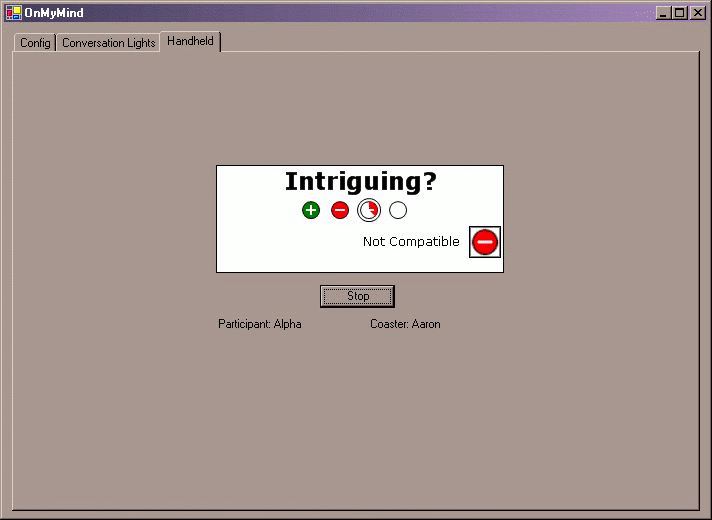
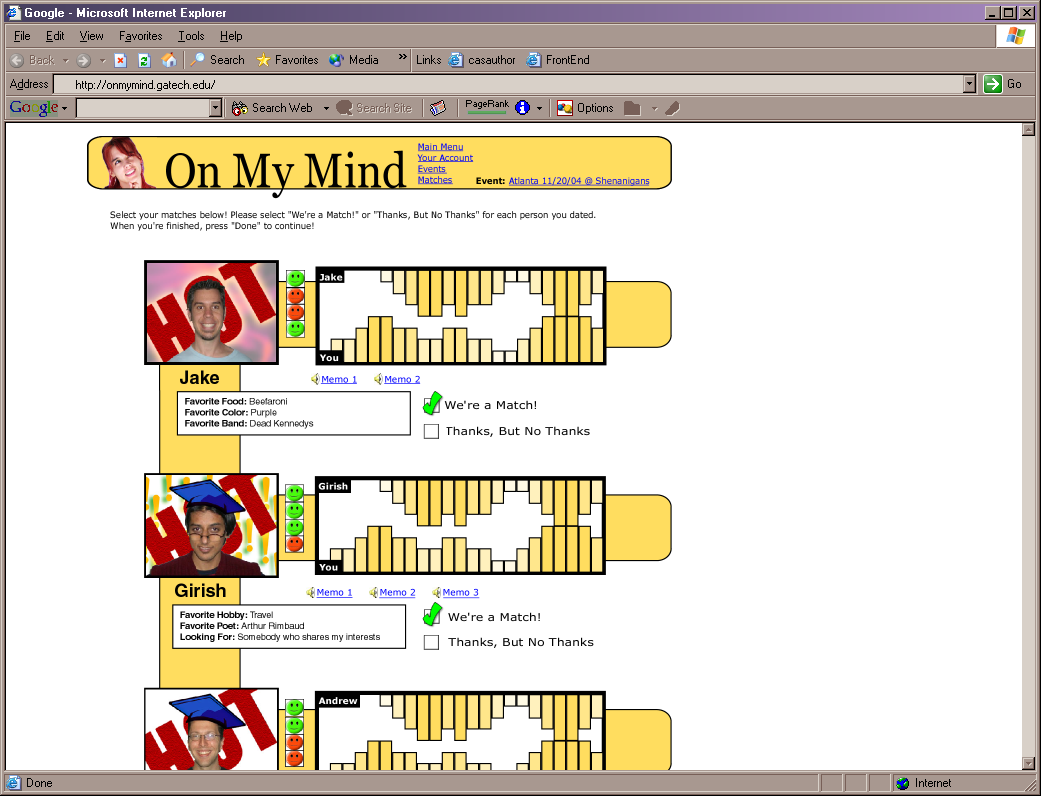
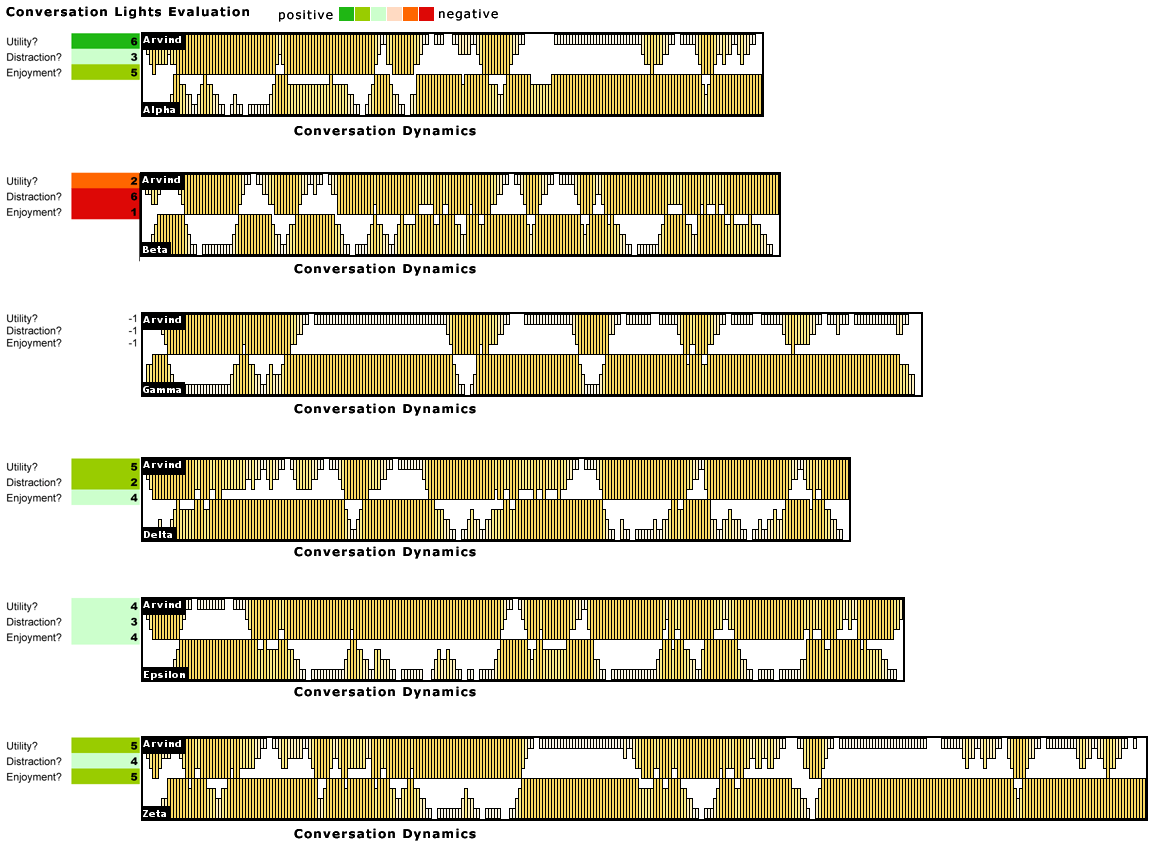
system of devices and software to aid recall, reduce anxiety, and help speed dating participants make better compatibility decisions. I built one of the devices embedded into the environment (the conversation lights), wired the internals of the handheld device, and wrote the software to drive the handheld and capture data during the evaluation. I also did the design and layout for the website used to view the results. My other team members designed and constructed the other devices, implemented the website, and created the media and materials necessary for our evaluation.
For our
evaluation, we
originally designed a study that tested both the usability and the utility of On My Mind. It was a complex experiment, with 36 participants and comprehensive testing of the system's features. Unfortunately, due to IRB delays we were forced to abandon our design and quickly develop a
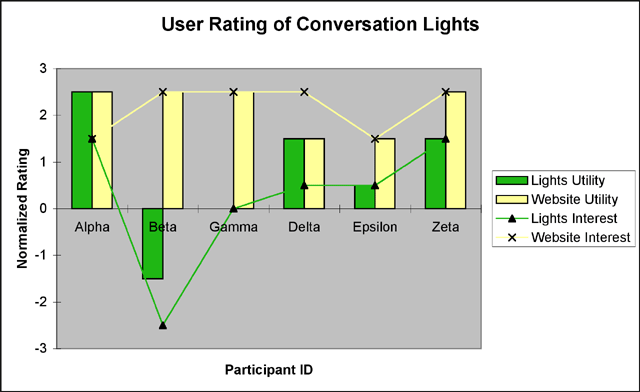
new protocol. Our final study used six participants and only tested the system's usability. Despite its limitations, our experiment generated a
rich variety of data and gave us
a clear path for further development of our product. I drafted the study protocol, consent forms and materiel, while other group members created the survey and observation instruments.
Command Post of
the Future
2004
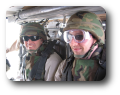 One of my last software development projects at MAYA Viz was Command
Post of the Future, a military command and control system. I went
to Baghdad for six weeks in 2004 to assist with deployment and usage
of the application. Prior to my trip, I had acted mostly in the role
of a programmer on the project. Once there, I spent most of my time
training users and supporting their activities. However, I also wanted
to take full advantage of the opportunity to do some (literally)
down-and-dirty qualitative research.
One of my last software development projects at MAYA Viz was Command
Post of the Future, a military command and control system. I went
to Baghdad for six weeks in 2004 to assist with deployment and usage
of the application. Prior to my trip, I had acted mostly in the role
of a programmer on the project. Once there, I spent most of my time
training users and supporting their activities. However, I also wanted
to take full advantage of the opportunity to do some (literally)
down-and-dirty qualitative research.
CPoF had many passionate defenders and a few equally passionate
detractors among division command staff. I set out to learn two
things: 1) What did our detractors do in their everyday usage of
the system?, and 2) How might we improve CPoF to better
assist them in their work?
To that end, I designed and conducted several informal interviews
with soldiers, and sat alongside them while they performed their
duties. I focused on two groups: Civil Affairs (who were amenable
to using CPoF but having difficulties), and the intelligence
collection cell (who were vehemently opposed to usage of the
application). I also worked with a military consultant to design a
survey, capturing the feature wishlists and best practices developed
by our most productive and creative users.
For Civil Affairs, I identified one key training issue and two software
issues. First, the nature of CA's work meant that several users with
different specialties needed to use the single workspace allocated
to their group. This led to two problems: a constant cycle of users
who weren't being trained properly, and who were struggling
with versioning and accidental deletion of each others' work. In
addition, CA users were often entering huge amounts of data by hand,
copying it from Office documents or military mapping software. To
address these problems, I altered our training schedule and gave
priority to CA staff. I also drafted a document for designers working
on future versions of the software, outlining my recommendations for
better support of history and workspace management. Finally, I
identified the key applications used by CA personnel, investigated
possible avenues of integration with those applications, and included
my recommendations in the document.
The intelligence collection cell presented a greater
difficulty. First, simply observing their work was impossible, as I
didn't have the proper clearance. Second, they were fiercely resistant
to usage of CPoF for unknown reasons. I found that their complaints
about CPoF's performance and bugs masked a more fundamental problem:
they needed several core capabilities that CPoF lacked, and CPoF
integrated poorly with the legacy tools that provided those
capabilties. I worked with one of our users to design a
solution for integrating the two applications, and created a detailed
design document outlining the necessary changes.
MAYA Viz, Ltd.
1998-2004
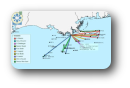 My experiences at MAYA Viz engendered my fascination with humans' use of technology.
On most projects, I worked closely with our information
designers to create powerful and usable interfaces. Project managers took notice
of my experience with information visualization, and I was often
called in to consult with new designers. I also went solo on
small projects that couldn't afford both a designer and a programmer, such as
sales demos or proof-of-concept exercises.
My experiences at MAYA Viz engendered my fascination with humans' use of technology.
On most projects, I worked closely with our information
designers to create powerful and usable interfaces. Project managers took notice
of my experience with information visualization, and I was often
called in to consult with new designers. I also went solo on
small projects that couldn't afford both a designer and a programmer, such as
sales demos or proof-of-concept exercises.